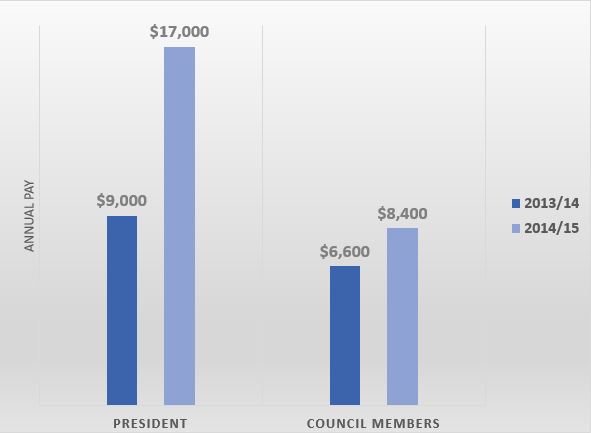
This year, USUSA officers — particularly the student body president — received a significant pay raise.
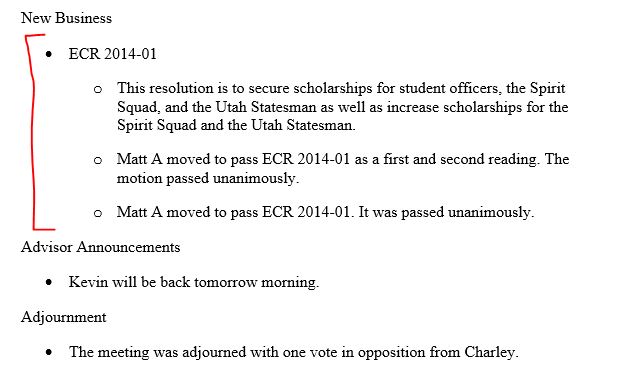
According to the executive council’s meeting minutes from February 13, the council was against giving themselves a pay raise. A “conflict of interest,” they called it.
Here are the meeting minutes from that day. Most of the officers that spoke agreed that there was a conflict of interest, and they didn’t want to be the ones to make the decision. Some thought there should be an increase in compensation, but most just wanted to “secure” their current scholarships, not increase them.
And ultimately, that’s what they decided. They approved the following piece of legislation — Executive Council Resolution 2014-01, or ECR 2014-01 — which moved their compensation from the president’s discretionary fund to Tier II Tuition:
So if the council didn’t ask for a pay raise, how exactly did they receive one?
The short answer is this — the administration chose to give them a pay raise.
“I get to decide, in the end, what the compensation is for these officers,” said Student Services Vice President James Morales. “That’s my responsibility.”
Dr. Morales said he looked at two major things when decided how to compensate the officers — the amount of work they do, and how our peer institutions compensate their officers.
“We do comparative studies,” he said. “We go and look at the U of U, we look at BYU, we look at SUU, Weber State. You know? We do the in-state comparison… And we look at their student leadership compensation, and we say, ‘Okay, are we equitable in terms of that pay, or that compensation?'”
In Utah, however, the amount that our student body president is being compensated is not equitable.
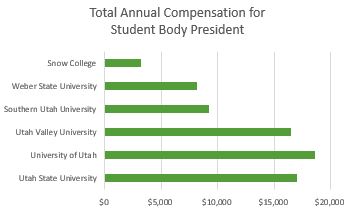
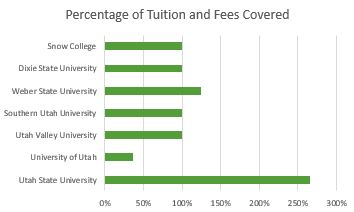
Maybe it is equitable — maybe our student body president is doing twice as much work as any other student body president in the Utah System of Higher Education. But after interviewing the majority of them, we learned that they work about the same amount of hours per week.
Either way, the student body president’s compensation increased by 89% and most of the other council members’ only increased by 27%. If the entire council had been given the same percentage increase, it would have nearly adjusted for inflation, which was — according to Dr. Morales — was one of the objectives of the increase. Instead, Doug Fiefia’s scholarship and stipend increased by $8,000, while most of the council members’ only increased by $1,800.
The following graphic breaks down exactly how the council got a pay raise — the legislation, decisions and people involved:
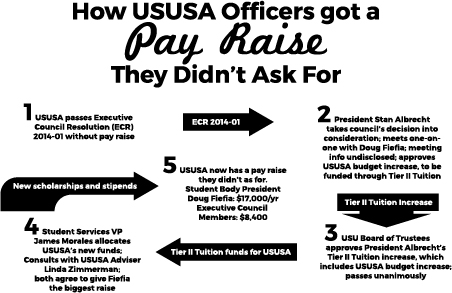
Credit: Chase Page, who is brilliant. And that’s not an opinion. That’s a fact.


Thanks for the article. Quick question. Could you go into further detail about your graphs? Maybe I am reading them wrong but I know that UVU’s tuition/fees are 5,270 a year and USU’s is around 6383 right? but it looks like UVU’s president is making almost $16,000. So wouldn’t that mean that the percentage of tuition and fees covered would be more than 100%? Thanks for your help!
Thanks for reading, Erika! I see how that can be misleading – but the graph is correct. It takes into account the percentage of tuition and fees covered by the scholarship per semester.