
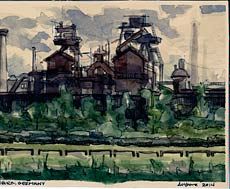
The exhibit “The Renaturalization of the Emscher River: A photographic documentation” opened on Nov. 10 in Merrill-Cazier Library at Utah State University.
The photographs were taken almost exclusively by Caine College of the Arts students on a study-abroad trip. The majority of the photos are of Germany’s Emscher River, which had been polluted by an open sewage system at the end of the 19th century and is now undergoing renaturalization, according to the exhibit’s introduction.
The project leader, Professor Chris Terry, wanted students to experience the culture of Germany that grew out of the end of the Industrial Revolution, dubbing it “industry, or industrial culture.”
“There’s been a long period of industrial development and it’s over now,” Terry said. “There’s no coal, hardly any steel. And instead of tearing it down they kept the developments up.”
“It surprised me. I never thought of industry being culture,” he said.
The remnants of the old landscape surround the Emscher River, allowing for a contrast of the industry of the past and the naturalization of the present and future.
“When we were walking along the Emscher our goal was to tell the story of the river, to visually show the process this river was going through,” said Brecken Bird, one of the student photographers from the trip.
“Sometimes it would make me want to get the old and the new in the picture at the same time, or the industrial and the natural in the picture at the same time,” said Anna Moore, another student from the trip. “I think the renaturalization topic encouraged me to try to capture the process where there were both things happening at the same time.”
“The Renaturalization of the Emscher River: A photographic documentation” is on display in Special Collections in the Merrill-Cazier Library until Dec. 12.


