
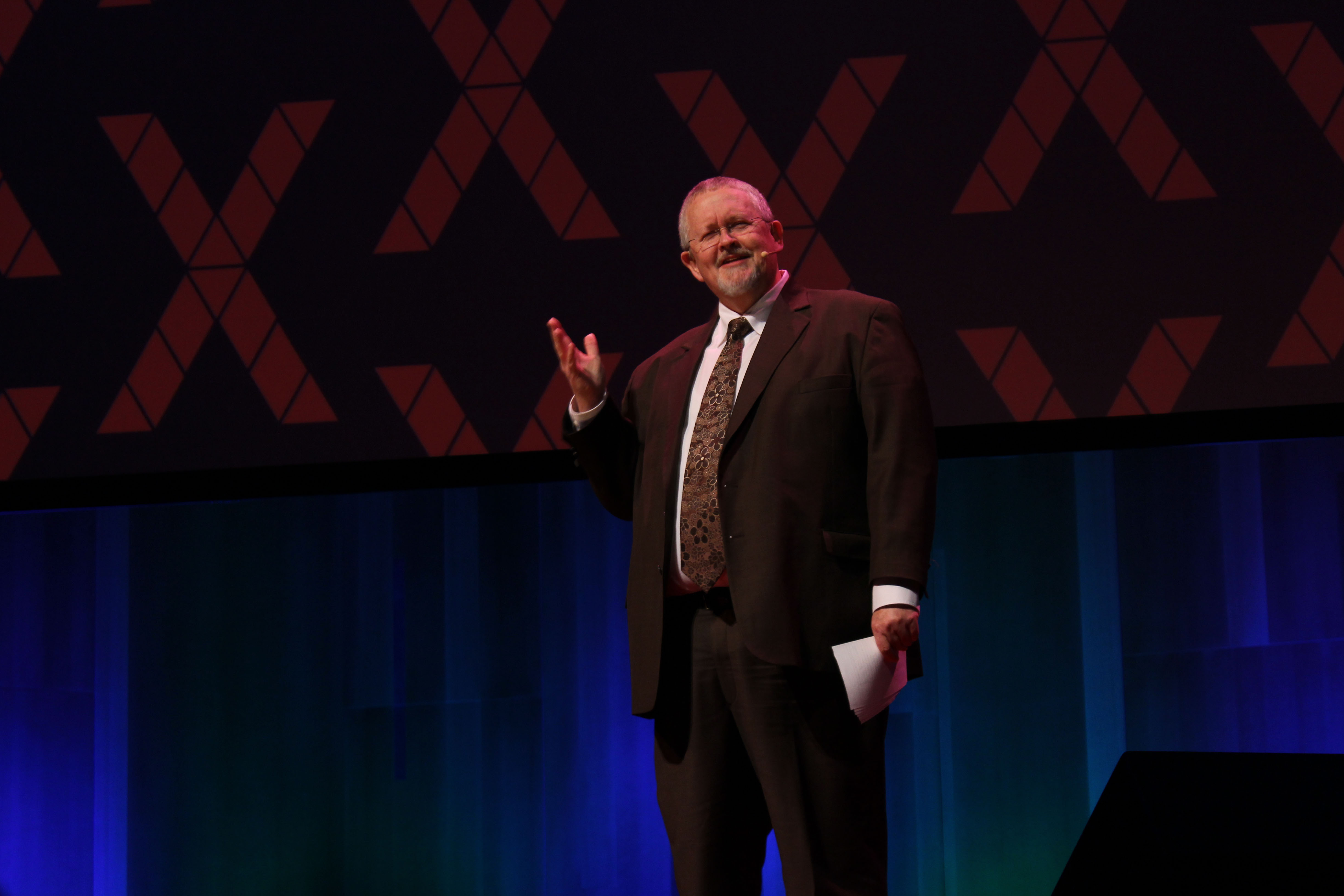
Orson Scott Card talks about the uselessness of homework. Photo credit: Amy Reid
On Wednesday, Utah State University’s Office of Research and Graduate Studies and the Caine College of the Arts hosted the third annual TEDxUSU conference in the USU Performance Hall. The event began at 3 p.m. and ran until 8 p.m. The conference was split into three sessions with 17 live speakers. Each year, TEDxUSU has a new theme. This year, the theme was friction.
First Session
Noelle Pikus Pace, a Utah Olympic athlete in skeleton, began the first session by explaining how something even as small as a shoelace can cause friction. In the 2010 Winter Olympics, Pikus Pace’s shoelaces were dragging on the ice which bumped her to fourth place by a tenth of a second. Throughout her talk, Pikus Pace continued to explain ways that friction set her back, including a bobsled injury and multiple miscarriages. However, she did not let her experiences hold her back and she returned to the sport of skeleton, winning the silver medal in the 2014 Sochi Winter Games.

Noelle Pikus Pace shows off her Olympic silver medal. Photo credit: Amy Reid
According to Pikus Pace, “Maybe we experience the things we do so that we can be a light and support to the people we meet.”

David Brown demonstrates the usefulness of a calculator in applied math. Photo credit: Amy Reid
Second speaker David Brown, a professor of mathematics at USU, spoke about changing the math curriculum in schools. His reasoning is that people do not appreciate the discipline as much as they should and that current curriculum halts students before they can fully recognize its value. To Brown, creativity is needed not only to teach but to learn mathematics. Brown left the stage with a tearful apology for the way students have been exposed to math.
The next two speakers were Deborah Fields and Lindsey Shirley.
Fields talked about tween activism in the online game, Whyville. When given the tools and freedom, tweens were able to point out racial problems within the game and bring about change.
Shirley talked about incorporating critical thinking to a creative process. Students in her class were given a design project which required them to think of new and reusable materials that would play into a particular dress theme. Shirley showed some examples from the class.
Following Fields and Shirley were Jason Quinn and Jenna Glover who both spoke on energy efficiency. Quinn focused on the energy costs and effect on global climate in regard to car tires. He stressed the importance of checking the air pressure every month. Glover focused on the personal energy people expend. To Glover, creating a routine and letting go of making certain decisions allows for higher energy throughout the day.
“Make fewer decisions and take some deep breaths to increase our energy and make changes,” Glover said.
As a break in the speakers, Jason Nicholson performed a personal composition on the five-octave marimba entitled “In Flux.”
According to the next speaker, Dennise Gackstetter, a lecturer in the Department of Art and Design, holding on to anger is exhausting. When in conflict, Gackstetter said it is best to get out of your head and into your body.
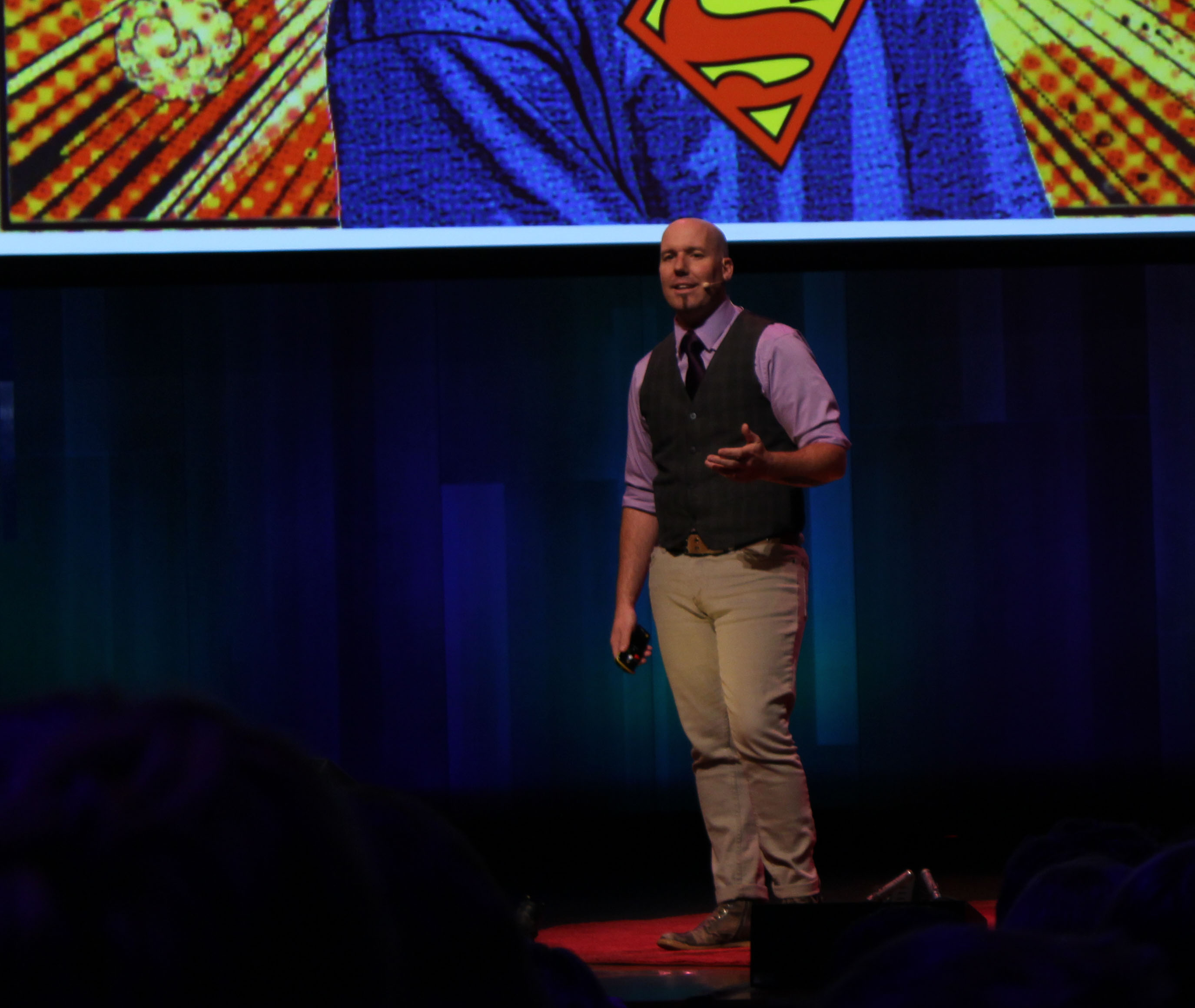
Matthew LaPlante talks about how everyone is super. Photo credit: Amy Reid
At the end of the first session, Matthew LaPlante opened his talk up to the audience by allowing them to send their live tweets to a screen on stage. This helped emphasize the premise that citizen journalism is overtaking the field of professional journalism. LaPlante compared professional journalists to superheroes such as Superman and Spiderman. He said that it is important that these “heroes” do not fear their own death, but rather train the everyday citizen so that the news can continue to live.
Second Session
During the second session, members of the audience were ushered to the new atrium at the Fine Arts Center for food and mingling with the presenters.
Third Session
Nicole Marineau, an undergrad studying biology and theatre education at USU, began the second session with a skit. This was her way of showing that the arts and sciences are connected and can be used to enhance each other in learning environments.
According to the next speaker, Evelyn Funda, “farming is the new sexy.” Funda focused on the way the media portrays farmers as always toned, tanned and ready for their photo shoots. She also pointed out the deep connection farmers have with American values and how that image has allowed agriculture to grow even if their practices don’t line up with those ideals. Because images can be deceiving, Funda stressed the importance of being a wise agricultural consumer.
Jarod Raithel used an apple to show and theorize that everything is evolutionarily interconnected. Raithel is a research fellow with the USU Ecology Center and over the years has found evidence to support interdependence.
“The more we look at separate ecological events, the more we find them hitched,” Raithel said.
The apple he used represented an evolutionary chain that connects all forms of life with the universe.
Melanie M. Domenech Rodríguez, a professor of psychology at Utah State, started the next talk by equating accidentally offending someone to stepping in dog poop: you didn’t mean to do it but now it’s all over your shoe. You must take the steps to clean it up. She discussed a moment in her own life when she accidentally made a racist comment to a friend, but by acknowledging her mistake, apologizing, thanking the friend and offering to make amends, she was able to grow from it.
The next speaker, Jim Davis, spoke about trust, what it means and how one earns it. He told the audience about his experience paragliding in Jackson Hole and how the instructor earned Davis’ trust.
“The three reasons we trust are ability (can they?), benevolence (do they care?) and integrity (will they?),” Davis said.
He also said that relationships are the essence that drive a company’s performance, and the essence of relationships is trust.
Before moving on to the final presenter, the audience was treated to a three-song performance by Dawn and Hawkes, an Austin-based indie-folk duo that earned their fame on NBC’s “The Voice.”

Dawn and Hawkes perform for the TEDxUSU audience. Photo credit: Amy Reid
TEDxUSU concluded with a talk by Orson Scott Card, author of “Ender’s Game,” among other best-selling books. He discussed family and school, and how his daughter’s love of reading was temporarily destroyed by an assigned reading journal.
“Too often,” Scott Card said, “schools today try to kill creativity.”
He stressed the importance of creativity and opposed homework, saying six hours a day was plenty for school. Instead, kids should be spending this time with family.


