
Welcome
When I think of gaming journalism, I tend to think back to gaming magazines of my formative years, magazines like GamePro and Nintendo Power. These magazines existed to inform the reader about upcoming and newly-released games, and ultimately they function as buyer’s guide by providing expert reviews which let the reader know whether or not a game is worth purchasing. Now the internet serves the same function magazines once did, and gamers have no shortage of outlets willing to provide reviews. What’s currently en vogue in gaming journalism is to eschew traditional review scores, but I think that’s a bit like throwing the baby out with the bathwater when it comes to solving the problems associated with traditional review scores. I’m not going to dive into those issues here, because I think those early magazines like GamePro got it right. Players want a review score to let them know if a game is worth their time. But just because reviews are subjective in nature doesn’t mean there cannot be some shred of objectivity. GamePro used a 5 point scale, with 0.5 increments, and I think I will hew closely to that. They rated on Graphics, Sound, Controls, and Fun Factor. I will be adding a fifth category, Replay Value, because I think that’s a crucial component in deciding whether or not a game is worth purchasing.
Establishing Criteria
Graphics – How a game looks. The visual component of games. This is pretty straight up for most people who have ever seen a video game. Some games elicit a strong aesthetic response which can be summarized as “ooh, shiny.” Other games are highly stylized and may not have photorealistic graphics, but a cohesive art style can do wonders for a game. Other games, like indie games, do not focus so much on graphics, and many of them use the 8 and 16 bit games of yesteryear as templates for their design.
Sound – How well the game sounds. Does the score match up to the gameplay? If it’s in an open world game, like Grand Theft Auto or Saints Row, how is the soundtrack? Is the voice acting good? Or is it grating?
Controls – How well a game controls. Different people have different levels of abilities, so this is how well I personally am able to control the game. Are the controls intuitive? If not, does a tutorial sufficiently teach them to you? Do I have to fight with the controls to get the character to do what I want them to do?
Fun Factor – How fun the game is. Fun is sort of a nebulous thing, especially in gaming, where some genres might be fun for some but not for others. Some games might start out fun, but then get old fast. Others maintain versatile gameplay and provide many hours of fun.
Replay Value – How replayble the game is. Some games are only worth a rental. Some are worth sticking on a shelf (or downloading to your console).
With that overly long preamble, let’s continue on to my first review.
Third Verse Breaks the Curse
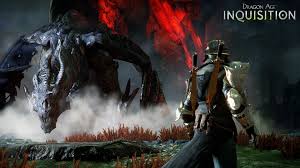
Dragon Age: Inquisition.
Release Date: 11/18/14
Platforms: PC, Xbox 360, Xbox One, PS3, PS4.
Dragon Age: Inquisition was in a precarious position. It had to be better than its last entry, Dragon Age II, which received scathing reviews in comparison to the well-lauded beginning of the franchise, Dragon Age Origins. It had to address the issues all of the critics and fans leveled at the series, and at the same time, win all those fans back who felt DA2 left a sour taste in their mouth. DA:I surprisingly manages to do that, but not without some caveats.
Graphics: The world of Dragon Age: Inquisition is lush and vibrant. Each area is massive and packed with beautiful detail. The characters themselves are well-represented. The monsters look ferocious, and the texture on the dragons is really incredible. However, despite being a beautiful game, there was some hiccups with visual fidelity, and the frame rate would dip occasionally. This was especially frustrating during long battles with dragons, and the game would start to get especially choppy toward the end of fighting them. When the game starts chugging, it’s hard to enjoy the beauty of the game. This is on the Playstation 4 version, by the way. Minus 1 half star. 4.5/5.
Sound: The music is nothing to write home about, mostly forgettable standard fantasy fare, but the songs in the tavern are rather enchanting, and the banter between characters is non-stop entertainment. I particularly liked hearing Sera, Blackwall, and Vivienne hashing it out, undercutting each other and making jibes. The banter alone makes me want to give it a 5, as the voice acting is all really well done, but the forgettable score makes me think I ought to subtract a point. 4/5.
Controls: One of my initial problems with Dragon Age: Origins was learning the controls, but I never had that problem here. You can hold down R2 to attack, or select from any one of your skills which automatically get mapped to the face buttons. Works for me. Freedom of movement is especially nice over its predecessors, as you can now jump around freely. You can switch between any of your characters at any time, or stop the action with the tactical camera allowing you to pause to input commands. I don’t think I ever ran into a problem with the controls. 5/5.
Fun Factor: One of the criticisms I’ve seen levied against DA:I is that is just a collection of fetch quests, and that’s true, to an extent. Other people describe the combat as boring. Even with my Knight Enchanter mashing triangle, I don’t think I was ever bored by DA, and I have almost 80 hours. Some might find the fetch quests redundant, but each one gives me a reason to stay in this beautiful world BioWare created a little longer. 5/5.
Replay Value: Low to High. I have about 80 hours, and have done nearly everything there is to do, and I am short 4 trophies. I will play through on Nightmare to unlock the last of them, so I am getting a second playthrough. People who want to do everything the game has to offer in one playthrough can start on Nightmare difficulty and get 100% of the trophies in one go. Others might want to do a clean-up playthrough as I am doing. Others still might try the mage, then the rogue, then the warrior, and end up getting three playthroughs out of it.
After getting the platinum trophy, it’s unlikely I’ll go back to it. There is also the multiplayer mode, but I have not played that, so cannot speak to its quality. ?/5.
That’s all folks. Join us next week when we look at Capcom’s Resident Evil HD Remaster.
-
Tone Deaf Jeff


